Holbein's portrait of Cromwell
Wolf HallHolbein's portrait of Cromwell is a 1534 image that turns its subject’s office, personal history, and political exposure into a study of how a man is seen—and how little a painted face can disclose. Its surrounding objects make administration visible; its still, watchful expression invites competing readings from those who know him; and Gregory’s silent response gives the portrait its most intimate measure.
Commission and Setting
The portrait’s arrival at Austin Friars in 1534 is presented through Cromwell’s hesitation before the finished work. He remembers his father, Walter Cromwell, demanding that he look him in the face when speaking a lie. That recollection makes looking a test of truth before the picture is even examined: Cromwell approaches his own likeness with the memory of a gaze that once challenged him.
Holbein has set Cromwell among the instruments of his working life: a quill, scissors, papers, and his seal in a small bag. A heavy, blackish-green volume, tooled in gold and gilt-edged, completes the arrangement. Holbein had asked to see Cromwell’s Bible but rejected it as too plain and well-thumbed; the finer book he found on Thomas Avery’s desk was a work by the monk Pacioli on keeping accounts, sent to Cromwell by friends in Venice. The choice replaces a familiar emblem of religious reading with a book of bookkeeping, placing the portrait’s emphasis on practical knowledge and the management of affairs.
The painted hand rests on the desk, holding a paper in a loose fist. Cromwell finds the sight uncanny because the image seems to divide him into particulars, finger by finger. Holbein has rendered the skin smooth, but captured the hand’s movement with an assurance that Cromwell associates with a slaughterman lifting a knife. The contrast gives the pose its force: the hand appears relaxed, yet its control carries a suggestion of action held in reserve.
Objects, Dress, and Political Exposure
The ring on the painted hand is Wolsey’s turquoise. Its presence links Cromwell’s current authority to the former cardinal whose service and fall continue to shape his position. It also sits beside an older personal association: Cromwell once had a turquoise ring of his own, heart-shaped and given by Liz when Gregory was born. The portrait’s ring therefore carries both political inheritance and private memory, without making them the same thing.
Cromwell had asked to be painted in his garden, but Holbein objected to the idea and kept the setting simple. Instead, the portrait encloses him in a small space: a heavy table seems to fasten him in, while his winter clothes make him appear compact and unusually resistant. Cromwell thinks he could be wearing armour. He anticipates that men in England and abroad may wish to stab him, and privately doubts they can reach his heart. The imagined armour is not a literal feature of the painting; it is Cromwell’s reading of the protected figure Holbein has made.
His face, however, does not disclose what occupied his mind while he sat. Cromwell recalls that his thoughts travelled elsewhere, to another country, but says they cannot be traced behind his eyes. The portrait fixes a visible likeness while withholding the movement of thought. Its stillness is therefore not simple transparency: the image offers details to inspect and leaves the subject’s inward life inaccessible.
The Household Reads the Image
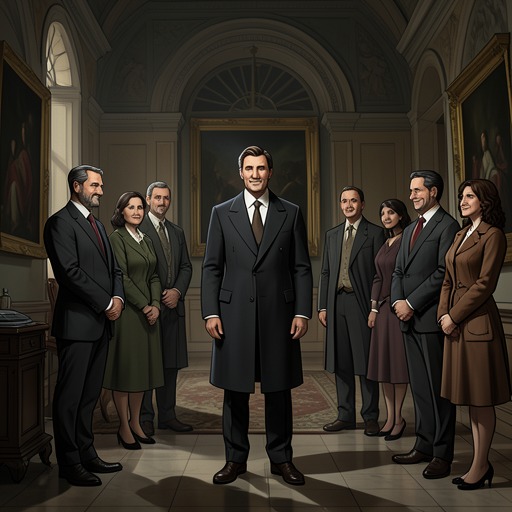
When Cromwell invites the household to see the picture, its reception turns the portrait into a scene of interpretation. Alice remarks that Holbein has made her uncle look stouter than necessary. Richard answers that, as Leonardo has demonstrated, a curved surface deflects cannon balls more effectively. The exchange turns a judgment of bodily appearance into a joke about protection, extending the portrait’s suggestion of armour without treating it as actual equipment.
Helen Barre distinguishes accurate features from an inaccurate expression: she says the likeness is true enough, but that this is not the expression Cromwell wears. Rafe replies that Cromwell saves that expression for men. Their comments separate resemblance from character. The portrait may record the features, but those closest to him dispute whether it has captured the face he presents in company—or the one reserved for confrontation.
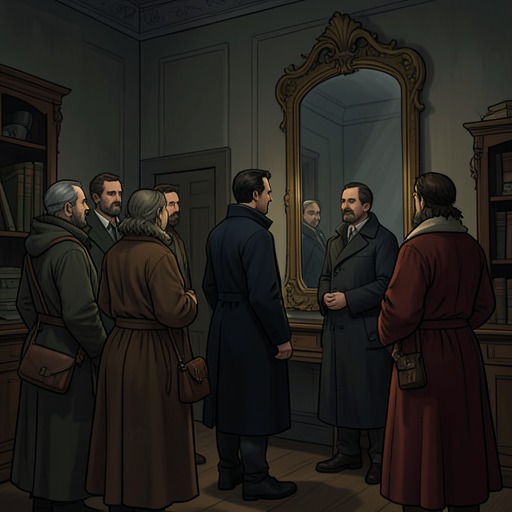
Chapuys, the Emperor’s ambassador, examines the painting by moving forward and back. He objects to the painter’s religious identity, but his sharper criticism concerns what the portrait asks its viewers to consider. Cromwell, he says, is never thought of alone: he studies other people’s faces as if intending to paint them, and makes those around him wonder what they themselves look like. Chapuys concedes that the image would make a viewer reluctant to cross Cromwell. His reading shifts the likeness from a record of Cromwell’s appearance to a portrait of his effect on other people: its subject is also a watcher, and the people before him become conscious of being watched.
Gregory and the Limits of Likeness
Cromwell asks Gregory to see the portrait alone, before the rest of the household can influence him. Gregory has just returned from Canterbury, still wearing his riding coat and muddy from the road. The circumstances make this a private exchange rather than a formal display: Cromwell wants his son’s opinion before anyone else can supply one.
Looking at the picture, Cromwell admits that he had imagined himself as he was when he left Italy twenty years earlier, before Gregory was born. He had not expected to discover that he was vain. The admission places the portrait between remembered youth and present self-image: the painted likeness confronts him with a version of himself he had not quite anticipated.
Gregory does not speak at first. Cromwell notices that his son is taller and, in his imagination, views him as a painter might: fair-skinned, hazel-eyed, and more like a figure in a fresco or an illuminated page than the hard young men who move through Austin Friars. He thinks Gregory is everything he has a right to hope for—open, gentle, reserved, and considerate in holding back his thoughts until he has formed them. The portrait prompts no easy pronouncement from the son; instead, the pause gives Cromwell room to look at Gregory and feel a tenderness so strong he thinks he might cry.
Cromwell turns back to the painting and recalls that a boy named Mark once called him a murderer. When he says that he fears Mark was right, Gregory answers, “Did you not know?” The exchange closes the family encounter with neither a verdict from Holbein nor reassurance from the son. The portrait records an expressionless face; those around it supply incompatible readings, while Gregory’s brief reply makes Cromwell confront the darker judgment attached to his public identity.